WHAT ARE YOU LOOKING FOR?
WHAT ARE YOU LOOKING FOR?
“To the Oak” is a classic by Shu Ting, one of the leading poets of the Misty school.
A poet of the Misty school, Shu Ting still writes with striking directness — and she names her subject in the very first line.
“If I love you”
Ask yourself: if I love you, what kind of person would I become? How would I carry myself?
The answer may not come easily — as with most questions, it is far simpler to say what we don’t want than what we do.
So Shu Ting writes:
Never like the climbing trumpet creeper, borrowing your high branches to show itself off
Never like the devoted bird, repeating its monotonous song to the green shade
And not only like a spring, bringing cool comfort year after year
And not only like a perilous peak, adding to your height, setting off your majesty
Why these particular images? The answer lies in how the poem came to be.
One evening, with the sea breeze blowing, Shu Ting walked on Gulangyu with the returned overseas poet Cai Qijiao. Lest there be any misunderstanding: Cai was not her lover at the time, but an older mentor who had helped her greatly with her writing. The two fell to talking about what young people look for in love, and the elder poet offered his view: “Pretty girls have no talent; talented girls are not pretty; and girls who are both pretty and talented are fierce.” In short, perfect girls are far too rare.
Shu Ting was angry. She found the remark deeply chauvinist, and that same night she sat down and wrote this poem to set out her own view of love.
So, strictly speaking, we have all misread “To the Oak”. It is not a love poem.
As for what “if I love you” should ask for, Shu Ting answers with a pair of vivid images, both drawn from trees.
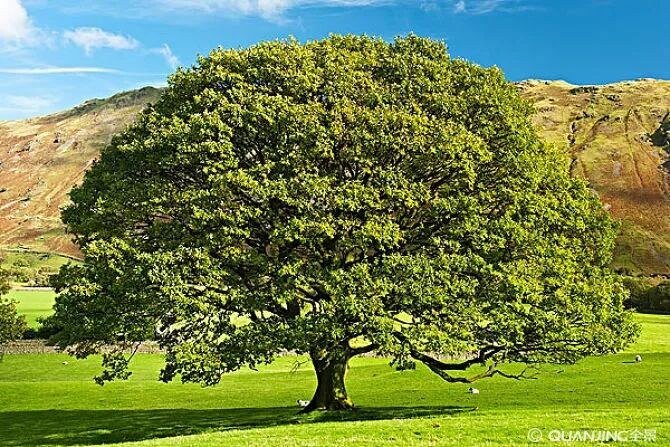
O oak
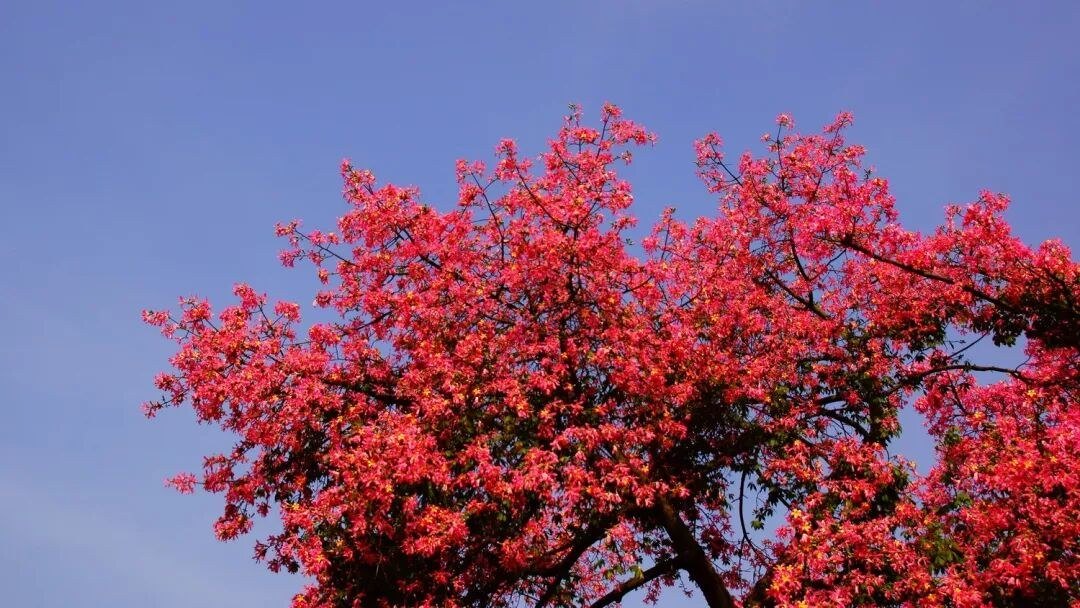
I must be a kapok beside you
standing with you as a tree.
Our roots clasped deep in the earth;
our leaves touching among the clouds.
The oak stands tall and straight
I must be a kapok beside you
standing with you as a tree.
Our roots clasped deep in the earth;
our leaves touching among the clouds.
The kapok is resilient and strong
I have my own crimson blossoms,
like a heavy sigh,
and like a brave torch.
This is Shu Ting’s inner monologue spoken through the kapok: the oak and the kapok together stand for the independent character and true feeling of two people in love. It is this symbolism that lets her deeply philosophical ideas reach readers in a warm, plain, tangible and easily grasped form — a rich, delicate literary beauty that readers can feel and understand.
The willow is gentle and slender, the poplar stubborn and plain, the camphor steadfast and fragrant, the maple deep in green and ablaze in red... Every tree has its own character, and gives us a different impression and a different association. This is the treasure box that nature and thought make together; each of us opens it and finds something different inside.
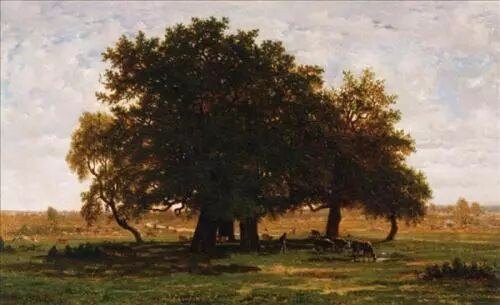
▲ “The Oak Grove”, Rousseau, oil on canvas, 1885
Just as Shu Ting speaks of the love between kapok and oak —
We share the cold waves, the thunder, the lightning;
we share the mist, the mountain haze, the rainbow.
As if forever apart,
yet bound for a lifetime.
This is what great love is,
and here is its constancy:
Love —
loves not only your towering frame,
but the place you stand,
the earth beneath your feet.

SEELAND WOOD LTD
B Block, Southern Ninth Street, Qiaotou Town, Dongguan city, Guangdong Province, China